Keep essays digital. Know they're real.
AI detectors don't work. Banning laptops hurts students who need them. BrightKite is a writing layer on top of Google Docs - teachers see the process, not just the product.
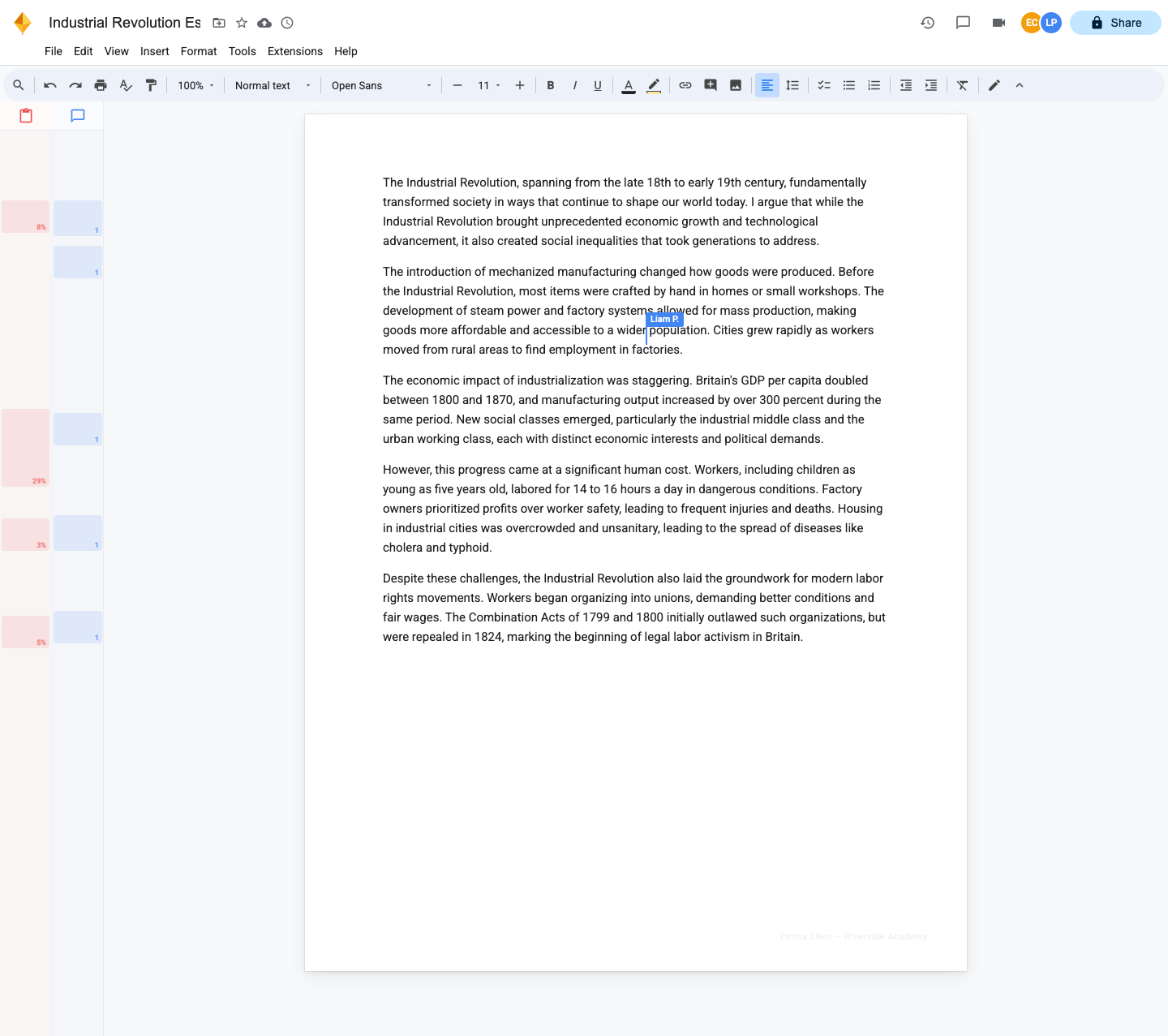
The Great Gatsby presents a complex picture of the American Dream through the character of Jay Gatsby, whose relentless pursuit of wealth reveals...
Fitzgerald uses the green light as a symbol [pasted from sparknotes.com] that represents both hope and the impossibility of...
typing... (42 wpm, 3 pauses in last paragraph)
AI hints that guide, not write
Subject-specific annotation packs nudge students without doing the work for them.
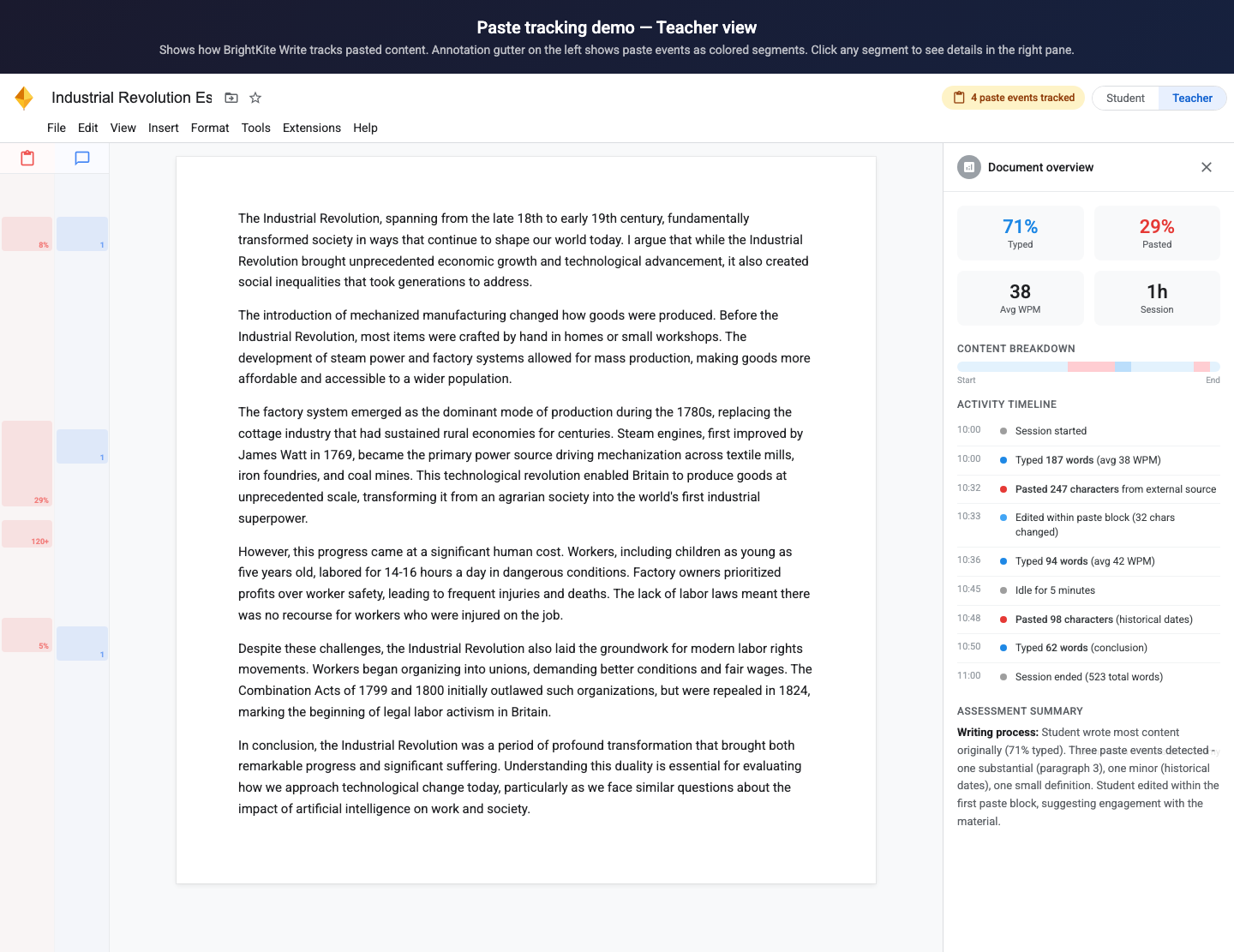
Every keystroke, every pause, every paste
See the writing process unfold. Paste provenance is permanent and can't be removed.
Teacher comments, their way
Your rubric, your standards. BrightKite supports your teaching style.
Three approaches schools are trying. None of them work.
Go back to handwriting
Blue book sales are up 80% at UC Berkeley. Universities are reverting to pen and paper as the "simplest enforcement."
- ✗ Only shows the final product, not the writing process
- ✗ Excludes students with disabilities who need assistive technology
- ✗ Kills the digital literacy skills students actually need
Trust Google Docs version history
Some teachers check version history manually. But it's designed for document recovery, not academic integrity.
- ✗ No paste detection - can't see what was copied from elsewhere
- ✗ Easy to game - type slowly into a separate doc, then paste in bulk
- ✗ Auto-suggestions mask whether the student actually knew the word
Run it through an AI detector
Turnitin, GPTZero, and others promise to catch AI-generated text. The research says otherwise.
- ✗ Stanford: 61% of ESL student essays falsely flagged as AI-generated
- ✗ Vanderbilt disabled Turnitin after estimating 750+ false accusations per year
- ✗ Detects after the fact - the damage is already done
The research is clear. The status quo isn't working.
From RAND to Stanford to the CDT - the data tells a consistent story about teacher burnout, unreliable AI detection, and the essay grading crisis.
AI detectors don't work
Seven popular AI detectors misclassified 61.3% of TOEFL essays written by non-native English speakers as AI-generated.
Liang et al., Stanford University, 2023
Vanderbilt University disabled Turnitin's AI detection entirely after calculating roughly 750 student papers could be incorrectly labeled as AI-written each year.
Vanderbilt University, 2023
Turnitin acknowledged finding a "higher incidence of false positives" on mixed-authorship work but declined to disclose the exact rate.
Turnitin / K-12 Dive, 2023
Turnitin labeled more than 90% of one international student's paper as AI-generated. The tool was much more likely to falsely flag non-native speakers.
The Markup, 2023
More than 40% of 6th-to-12th-grade teachers used AI detection tools last school year, despite research showing these tools are unreliable.
Center for Democracy and Technology, 2024
Teachers are burning out
Teachers are roughly twice as likely to experience frequent job-related stress or burnout compared to similar working adults.
RAND Corporation, 2024
67% of educators consider burnout a "very serious" issue - two-thirds of teachers say we've reached crisis levels.
National Education Association, 2024
One in five teachers under 30 plan to leave the profession within five years. In some systems, that figure rises to half.
OECD, TALIS 2024
Teachers work 54 hours per week on average, with just 46% of their in-school time actually spent teaching.
EdWeek Research Center, 2022
Grading is drowning English teachers
A high school English teacher grading essays at 20 minutes each, across six classes of 25 students, spends 50 hours on a single round of grading.
KQED / Hechinger Report, 2024
The average high school English teacher in California has roughly 180 students. A single essay assignment can require 2-3 weeks of grading work.
CalMatters, 2024
Schools are going backwards
Blue book sales up 80% at UC Berkeley, 50% at the University of Florida, and 30% at Texas A&M - universities are reverting to handwriting exams.
Entrepreneur / Daily Cardinal, 2025
58% of students who know they're being monitored say they don't share their true thoughts or ideas because of surveillance software.
Center for Democracy and Technology, 2023
Nobody has a policy
Only 34% of teachers said their school had policies related to AI and cheating. 80% of students said their teachers never provided guidance on AI use.
RAND Corporation, 2024
59% of higher education leaders believe cheating has increased since generative AI became widely available, with 21% saying "a lot."
AAC&U / Elon University, 2024
28% of teachers in high-AI-use schools reported a data breach, compared to just 18% in low-AI-use schools. More tools, more risk.
Center for Democracy and Technology, 2025
When AI detectors wrongly flag essays as suspicious, they chip away at trust. Teachers begin to doubt their best writers.
Inside Higher Ed, 2025
Over 411,000 teaching positions in the U.S. are either unfilled or filled by teachers without full certification - about 1 in 8.
Learning Policy Institute, 2025
BrightKite - a writing layer, not another platform
A secure layer on top of Google Docs that gives teachers visibility into the writing process. Files never leave Google Drive.
See how students write
Keystroke analytics show speed, pauses, and editing patterns. Writing fingerprints unique to each student.
Know what was pasted
Every paste event logged with source provenance. Permanent, can't be removed. Your policy, your rules.
AI hints, your way
Subject-specific annotation packs give students nudges - your rubric, your standards. AI guides, not writes.
Your rubric. Your style. Less busywork. Files never leave Google Drive.